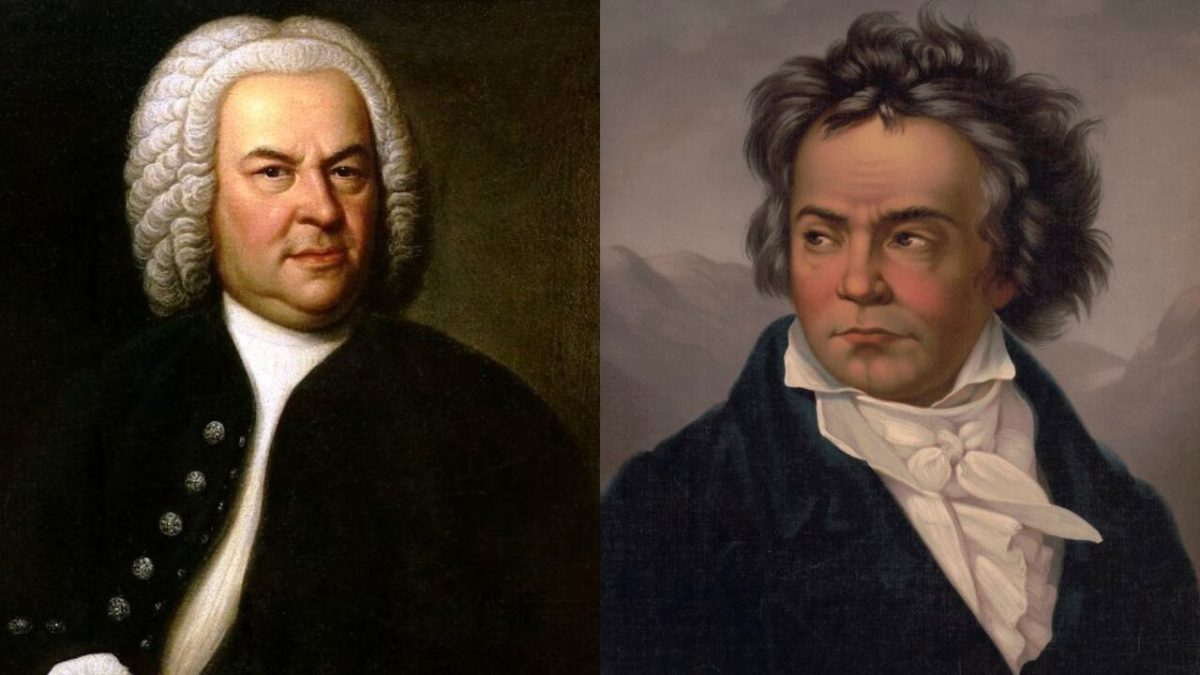
Say “classical music!” and the happy chimes of Mozart ring in most ears. Yes, Mozart was one of the greatest composers of the Classical era (1750-1800), but the term “classical music” actually refers to a 400-year-old-and-continuing tradition of Western music, spanning a vast array of styles and sounds far beyond the primly-cut tunes of Mozart. Out of this tremendous pile have stood out a small group of “great” composers and great music, and even higher stand the pillars of the “greatest” composers of all time. Cases have been made for several candidates—Stravinsky, Debussy, Brahms—but by far the most contentious debate rages on between two musical giants: Johann Sebastian Bach (1685-1750) and Ludwig van Beethoven (1770-1827).
For the past 5 years or so I’ve had my ballot firmly in Bach’s box. Composing in the Baroque period and style (which lasted roughly from 1600-1750), his works have been studied by virtually all the great composers who followed him, including Beethoven, and his absolute mastery of harmony and counterpoint continues to intimidate composers to this day. As Wayne Hills instrumental music director and music theory teacher Ms. Pascale puts it, “You can argue Bach walked so Beethoven could run.” A devout Protestant in 18th century Germany, he composed music for churches and was known throughout his lifetime as an organist. Today, he is known as a master technician of music, perhaps the master technician, and, after listening to his Brandenburg Concerto No. 1, I was convinced.
Beethoven, though skilled in his own right, was known for something different. In his lifetime the European musical scene was entrenched in the stiff norms of the Classical style, practiced most famously by Franz Joseph Haydn and Wolfgang Amadeus Mozart. Beethoven’s earlier works followed in this tradition, though by 1800 his music was beginning to show signs of rebellion, revolution. From 1802 to 1804 he composed his third symphony, the Eroica (“Heroic”), which broke away from the harmonic and stylistic norms of his predecessors and arguably marked the beginning of a new musical period, the Romantic era (1800-1910). In this and later symphonies there was a rawness of emotion, of individual artistic expression that began the long tug at the old musical traditions that would continue for over a century, all the way up to the atonalism of Schoenberg.
From Beethoven the composers who succeeded him each took away something different and expanded upon it. Brahms added harmonic and motivic complexity to the symphony, Wagner dramatized the programmatic element of his works into massive operatic dramas, Bruckner kept faith to his four-movement symphonic form and made it longer and lusher, Mahler took the individualism, passion, ecstasy and agony of his works to the extreme. Nearly all composers of Europe—French, German, Finnish, or English—made music in the shadow of Beethoven.
And yet, before he even finished his third symphony he was beginning to suffer from a tragic development: the painful decline of his hearing. In his Heiligenstadt Testament he writes to his brothers, “what a humiliation when one stood beside me and heard a flute in the distance and I heard nothing, or someone heard the shepherd singing and again I heard nothing, such incidents brought me to the verge of despair, but little more and I would have put an end to my life—only art it was that withheld me, ah it seemed impossible to leave the world until I had produced all that I felt called upon me to produce, and so I endured this wretched existence—truly wretched.”
By the completion of his eighth symphony in 1814 he had lost virtually all of his ability to hear. He withdrew from society and performance but kept on composing, kept making music. In 1824 he completed his ninth symphony and that same year he went up on stage to “conduct” the premiere, with an orchestra he could not hear. After the symphony’s end he was still conducting, eyes closed, several bars off, until the contralto Caroline Unger turned him around to, after a decade off stage and a lifetime of turmoil, thunderous applause and ovations.
Today Beethoven stands not only as a monumentally influential musician but as the hero of one of the most inspiring stories in history of the unbending strength and fortitude of the human soul. That is why Ludwig van Beethoven, who lived and suffered for his art, for those like us who over two centuries still listen to his music which he himself could barely hear, is the greatest composer of all time.