“That’s one small step for man, one giant leap for mankind,” said Neil Armstrong when America first landed humans on the Moon in 1969. More than 50 years later, NASA has taken another major step toward returning astronauts to the lunar surface.
NASA officially launched Artemis II on April 1, 2026, beginning a nearly 10-day voyage around the Moon. The mission did not land on the Moon, but it was a major test flight designed to prepare NASA for future Artemis missions, including a planned return of astronauts to the lunar surface in 2028.
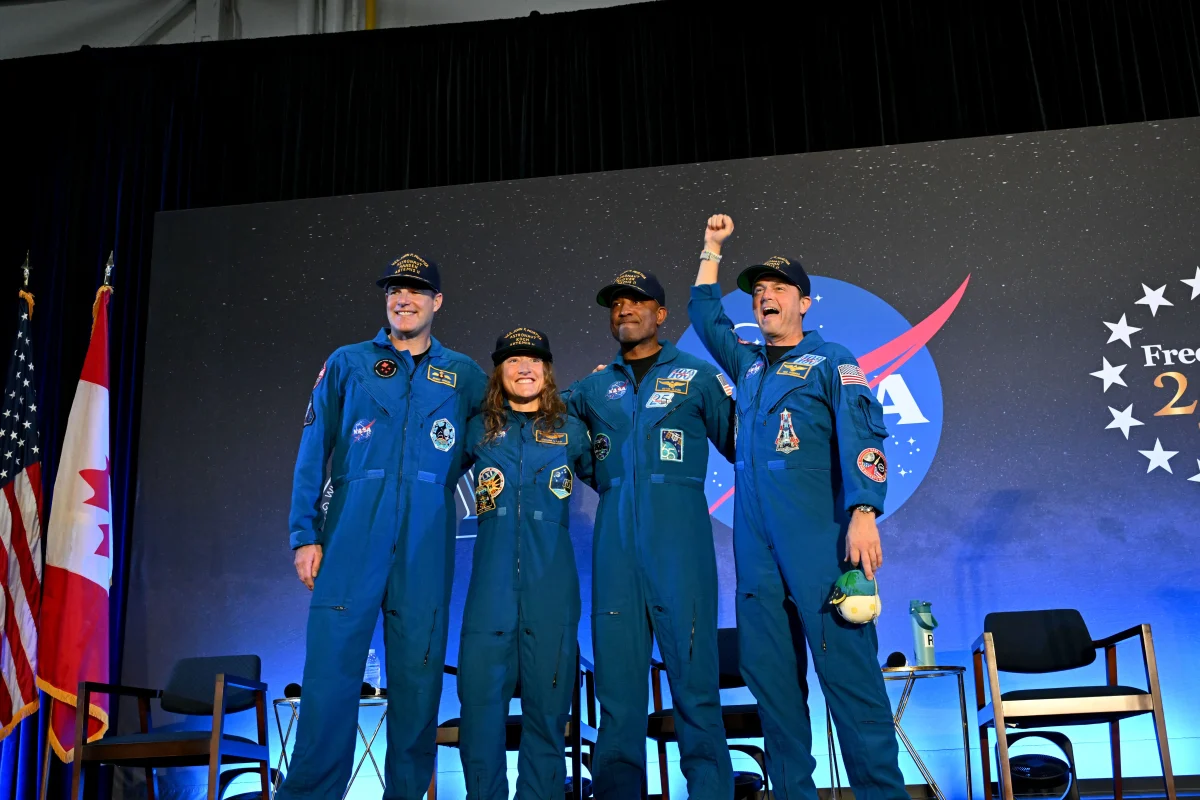
The crew traveled farther from Earth than any human in history, reaching about 252,756 miles from Earth’s surface at their farthest point. Artemis II was also the first crewed flight of NASA’s Orion spacecraft. The astronauts on board were Reid Wiseman, Victor Glover, Christina Koch, and Jeremy Hansen. Christina Koch became the first woman to travel around the Moon, while Jeremy Hansen became the first Canadian astronaut to travel to the Moon.
However, the preparation for this journey was not easy. Before the mission, the crew trained in challenging environments, including Iceland’s volcanic terrain, to practice navigation and geology skills in conditions similar to areas astronauts may encounter during future lunar exploration.
During the mission, the Artemis II crew tested Orion’s developmental and navigation systems while also contributing to studies about sleep, motion, human physiology, and how the human body responds to deep-space travel. These tests are important because future Artemis missions will require astronauts to travel farther, stay longer, and eventually live and work near the Moon.
Additionally, Wayne Hills physics teacher Ms. Sherger shared, “I happened to be visiting family about 20 miles south of Cape Canaveral during spring break, so I was lucky enough to just walk out on the beach and watch the Artemis launch! It was the first time I saw a launch of any kind, so it was very special. Apparently, 400,000 people visited the area to watch it that week.” She further mentioned, “I think the long-term goal of the Artemis program is to eventually establish a long-term presence on the moon. This particular mission sent the first woman to orbit the moon and went further out into space than any previous mission.”
NASA released a 10-day recap of the crew’s mission milestones, including images and videos from the voyage.
The mission ended successfully when Orion splashed down in the Pacific Ocean off the coast of San Diego on April 10, 2026. This record-breaking voyage surpassed the distance traveled by Apollo 13 in 1970 and marked the farthest humans have ever traveled from Earth.
For more photos of the return voyage, NASA’s splashdown and recovery gallery can be found here.
The question everyone wants to know is: What comes next for space travel under the Artemis program? NASA’s next steps include testing docking and landing systems before sending astronauts back to the Moon’s surface. If successful, Artemis will not only return humans to the Moon for the first time in over 50 years, but also help prepare for future missions to Mars.