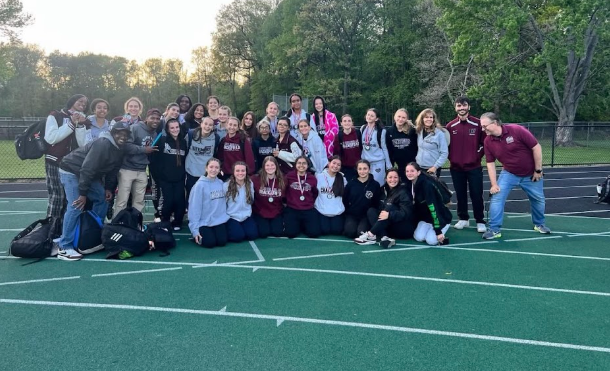
Track and field is a bit of an anomaly in regard to high school sports. Teams rarely, if at all, compete head to head at competitions as done in sports such as basketball or volleyball. Rather, track and field competitions consist of a series of often disparate events (split by sex) in which individual athletes compete against each other, such as the discus throw and 400 meter race. While most people are familiar with the sport held outdoors in the spring, there is also an indoor variant which is held in the winter. I interviewed Sawyer Hinds, a junior who has been a part of the team since his freshman year, to learn a little more about the team.
The Wayne Hills Indoor Track and Field team, in addition to being more obscure in comparison to its outdoor counterpart (there are significantly less people who are a part of the Indoor Track and Field team), has its athletes facing several hindrances due to its nature of being held indoors. The biggest issue is the lack of a dedicated training facility for the athletes: while some schools have an entire indoor track and field stadium onsite, Wayne Hills sadly lacks such a facility of its own. This means that during competitions, where such a facility is required for a competition, the team must travel up to an hour in some cases in order to compete. Sawyer tells me that “the long bus rides help build team spirit and unity.” The lack of an indoor track and field stadium also leaves the team with a tough decision to make: to practice outside in poor weather on the track or stay indoors and make do with what facilities are available. This year, Sawyer tells me that for most of the season the team has had to practice indoors.
Despite the suboptimal conditions on top of the rigorous training required for athletes, Sawyer speaks admirably of coaches Jason Staggers and Jaris Rousseau, “the coaches [being] very professional and responsible with the team members.” This is no surprise—Coaches Rousseau and Staggers are not only involved with Wayne Hill’s Indoor Track and Field team, but also with its outdoor counterpart in the spring and the Cross Country team in the fall. In addition, the two coaches have worked together for years, so it is to be expected that the coaches are well-versed in both the matters of the sport and in training the students they mentor.
Under coaches Rousseau and Staggers, the team sends about 10 people to the State Championship every year, according to Sawyer. He believes that this number is bound to rise, as “there are a lot of talented underclassmen. So this number could go up in the next few years.” To conclude my interview, I asked Sawyer about an aspect of the sport that would be difficult to find in other school sports and extracurricular activities, from his perspective as a runner. “Well during races, it’s just you running, so there is very little obvious “team” aspect of the sport,” he explained. “So individual goals can be made much more concrete and it is easier to hold yourself accountable in reaching whatever goal you set out for yourself.”
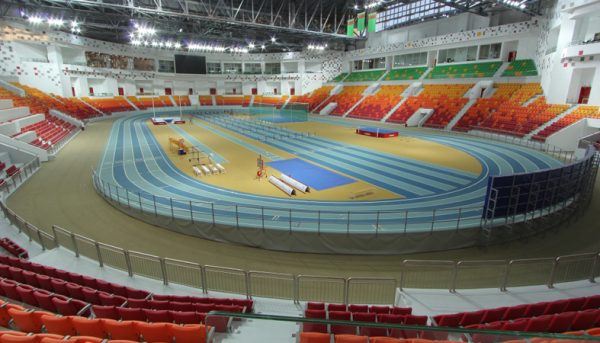
Credit- Mondo
https://www.mondoworldwide.com/na/en/spaziomondo/doyouknow/athletics-tracks-indoor-facilities-different-types/ (Unknown)